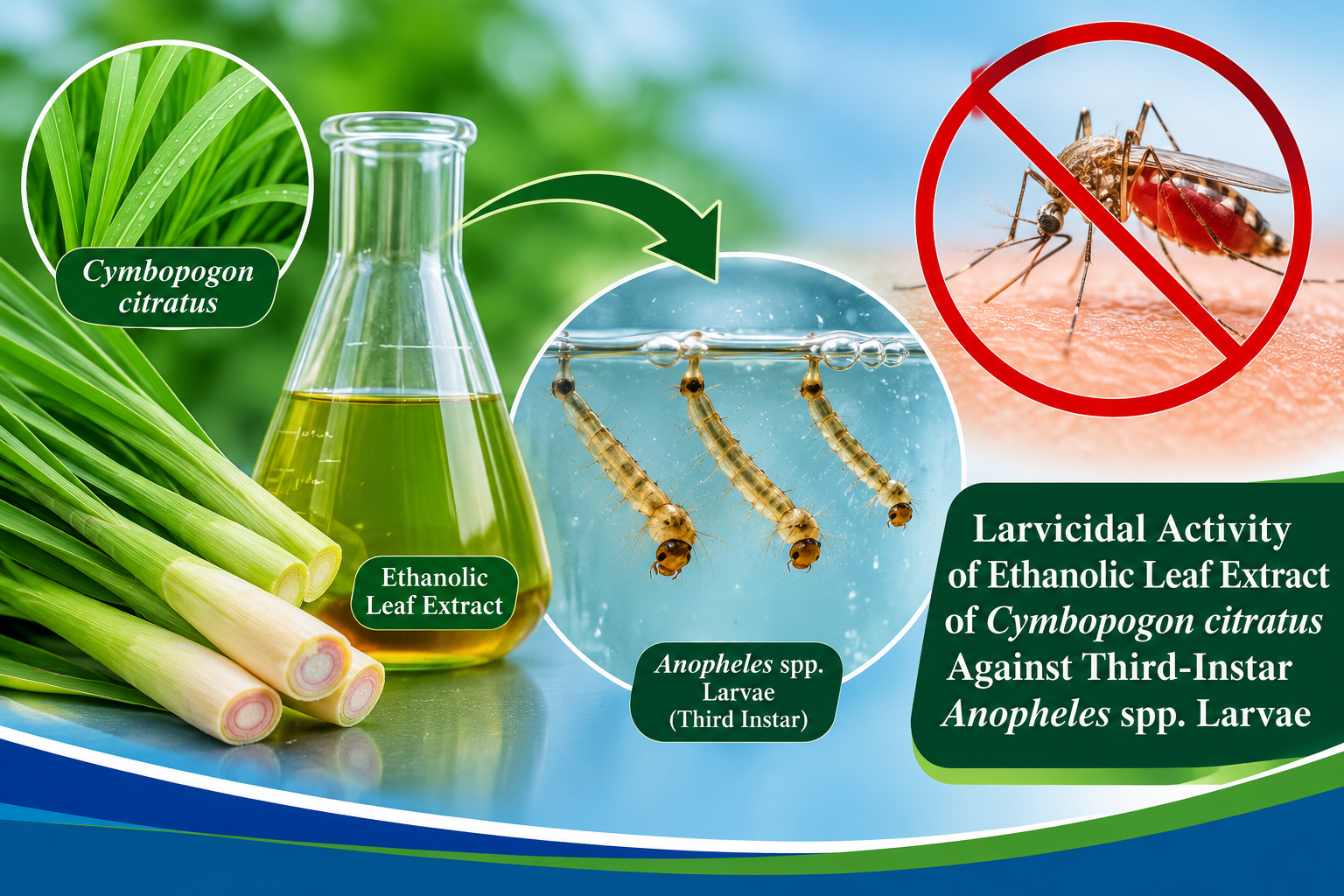
Larvicidal Activity of Ethanolic Leaf Extract of Cymbopogon citratus Against Third-Instar Anopheles spp. Larvae
DOI:
https://doi.org/10.59493/advpbl/2026.1.10Keywords:
Anopheles spp, botanical larvicide, Cymbopogon citratus, integrated vector management, larvicidal activityAbstract
Resistance development and environmental toxicity limit the use of synthetic insecticides. Under controlled laboratory conditions, this study assessed the larvicidal activity of the ethanolic leaf extract of lemongrass (Cymbopogon citratus Stapf, Poaceae) against third-instar Anopheles spp. mosquito larvae. Fresh lemongrass leaves were collected, authenticated, shade-dried, and macerated in ethanol for 72 h to yield a crude extract. Larvae were raised to the third instar and subjected to extract concentrations of 62.5, 125, 250, and 500 ppm in triplicate bioassays. Mortality rate was observed at 1, 2, 24, and 48 hours after exposure. The extract was subjected to Fourier Transform Infrared (FTIR) spectroscopy and proximate analysis. Results indicated that the highest concentration (500 ppm) produced 94.67±2.31% mortality after 48 h, while 62.5 ppm yielded only 13.33± 2.31% mortality. The lethal doses (LC50 and LC90) that resulted in 50% and 90% mortality at 48 h were 204.3 ppm and 612.1 ppm, respectively. FTIR analysis identified absorption bands consistent with functional groups of phenolics, flavonoids, terpenoids, aldehydes, and essential oil constituents. Proximate analysis revealed a carbohydrate-dominant profile (27.01±1.58%), with considerable crude fat (24.41±1.25%), moisture (21.49±1.09%), ash (14.63±1.87%), and crude protein (12.47±0.36%) levels; crude fiber was undetected. These findings demonstrate that C. citratus possesses meaningful concentration- and time-dependent larvicidal activity against Anopheles larvae, supporting its development as a potential locally available, biodegradable, and environmentally friendly botanical larvicide for integrated mosquito vector management.
References
WHO, 2022. World malaria report 2022. World Health Organization: Geneva. https://www.who.int/teams/global-malaria-programme/reports/world-malaria-report-2022
CDC, 2024. Centers for Disease Control and Prevention. Larvicides. https://www.cdc.gov/mosquitoes/mosquito-control/larvicides.html
U.S. Environmental Protection Agency, 2024. Controlling mosquitoes at the larval stage. https://www.epa.gov/mosquitocontrol/controlling-mosquitoes-larval-stage
WHO, 2005. Guidelines for Laboratory and Field Testing of Mosquito Larvicides. WHO Communicable Disease Control, Prevention and Eradication. World Health Organization: Geneva. https://www.who.int/publications/i/item/WHO-CDS-WHOPES-GCDPP-2005.13
Dusfour I, Chaney SC, 2022. Mosquito control: Success, failure and expectations in the context of arbovirus expansion and emergence. In: Hall M, Tamïr D, editors. Mosquitopia: The Place of Pests in a Healthy World. New York: Routledge; Chapter 14. https://doi.org/10.4324/9781003056034-19
Ranson H, Lissenden N, 2016. Insecticide Resistance in African Anopheles Mosquitoes: A Worsening Situation that Needs Urgent Action to Maintain Malaria Control. Trends in Parasitology, 32 (3):187-196. https://doi.org/10.1016/j.pt.2015.11.010
Hemingway J, Ranson H, Magill A, Kolaczinski J, Fornadel C, Gimnig J, Coetzee M, Simard F, Roch DK, Hinzoumbe CK, Pickett J, Schellenberg D, Gething P, Hoppé M, Hamon N, 2016. Averting a malaria disaster: will insecticide resistance derail malaria control? Lancet, 23; 387(10029):1785-1788. https://doi.org/10.1016/s0140-6736(15)00417-1
Pavela R, 2015. Essential oils for the development of eco-friendly mosquito larvicides: A review. Industrial Crops and Products, 76: 174–187. https://doi.org/10.1016/j.indcrop.2015.06.050
Benelli G, Jeffries CL, Walker T, 2016. Biological Control of Mosquito Vectors: Past, Present, and Future. Insects, 7(4):52. https://doi.org/10.3390/insects7040052
Govindarajan M, Mathivanan T, Elumalai K, Krishnappa K, Anandan A, 2011. Mosquito larvicidal, ovicidal, and repellent properties of botanical extracts against Anopheles stephensi, Aedes aegypti, and Culex quinquefasciatus (Diptera: Culicidae). Parasitology Research, 109(2):353-367. https://doi.org/10.1007/s00436-011-2263-1
Abdullahi HA, Abubakar MM, Sunusi S, Namadi I, Shuaibu T, Yunusa H, Adam SI, Shuaibu H, Haruna A, 2025. Evaluation of Plant Extracts as Larvicides Against Anopheles Mosquitoes for Malaria Control in Dutse, Jigawa State, Nigeria. Dutse Journal of Pure and Applied Sciences, 11(2a): 1-9. https://doi.org/10.4314/dujopas.v11i2a.1
Ghurde K, Kawade S, 2026. Plant Extracts as potential mosquito larvicides with special emphasis on Neem (Azadirachta indica): A Review. Journal of Emerging Technologies and Innovative Research, 13(4): f88-f97
Shah G, Shri R, Panchal V, Sharma N, Singh B, Mann AS, 2011. Scientific basis for the therapeutic use of C. citratus, Stapf (Lemon grass). Journal of Advanced Pharmaceutical Technology Research, 2(1):3-8. https://doi.org/10.4103/2231-4040.79796
Siqi Wan, Bingcong Xing, 2025. Research progress on chemical composition, biological activity and application of lemongrass and its essential oils, Journal of Functional Foods, 135: 107083, https://doi.org/10.1016/j.jff.2025.107083
Wahedi JA, Vincent VM, Pukuma SM, Bawa IS, Agboola OO, Aju-Ahmeh CO, Filgona J, Olowoyo JO, 2024. Phytochemical screening and larvicidal activities of Cymbopogon citratus and Annona senegalensis against Culex quinquefasciatus, Scientific African, 23, e02057. https://doi.org/10.1016/j.sciaf.2024.e02057
Manh HD, Hue DT, Hieu NTT, Tuyen DTT, Tuyet OT, 2020. The Mosquito Larvicidal Activity of Essential Oils from Cymbopogon and Eucalyptus Species in Vietnam. Insects, 11(2):128. https://doi.org/10.3390/insects11020128
Deekshith A, Hamid K, Gupta S, Karumanchi SK, Posa MK, Prasad DA, Singh SP, Vigneswari S, 2024. Larvicidal activity of lemongrass leaf extract on mosquito larvae. Frontiers in Health Informatics, 13(3): 5431-5436.
Mutagwaba E, Urassa R, Ngenda E, Mafuru T, Matinde R, Kimaro E, Kapala J, Thomas A, Joseph T, Luanda A, 2025. Comparative larvicidal efficacy of essential oils from C. citratus stalks and leaves against Anopheles gambiae sensu stricto. Malaria Journal, 24(1): 444. https://doi.org/10.1186/s12936-025-05675-1
Tariwari CAN, Ebibodere KB, 2020. Biolarvicidal Activities of the Crude and Ethanol Extracts of Lemon Grass (C. citratus) Against Anopheles gambiae. Greener Journal of Biological Sciences, 10(1): 38-41.
Dawam NN, Akwashiki O, Dawam NN, Nicholas F, 2024. Waste tires as Breeding Ground for Mosquitoes: An Environmental and Public Health Challenge in Nigeria. Direct Research Journal of Public Health and Environmental Technology, 9(2):183 -191. https://doi.org/10.26765/DRJPHET400197586
Topluoglu S, Karasartova D, Karaer Z, Özkan A, 2020. Morphological identification of Anopheles larvae and investigation of physical and ecological characteristics of reproduction areas in Sanliurfa region. Turkish Bulletin of Hygiene and Experimental Biology, 77, 207-216. https://doi.org/10.5505/turkhijyen.2019.00087
Pam VA, Adejoh VA, Ombugadu A, Maikenti JI, M. Ashigar MA, 2026. Local habitat conditions drive morphometric variations, but not spatial patterns of Anopheles mosquitoes in North-Central Nigeria. FULafia Journal of Science and Technology, 10(2), 18-21. https://doi.org/10.62050/fjst2026.v10.n2.805
Lee JE, Jayakody JTM, Kim JI, Jeong JW, Choi KM, Kim TS, Seo C, Azimi I, Hyun JM, Ryu BM, 2024. The Influence of Solvent Choice on the Extraction of Bioactive Compounds from Asteraceae: A Comparative Review. Foods, 13(19):3151. https://doi.org/10.3390/foods13193151
Pearson D, 1973 Laboratory Techniques in Food Analysis. Butterworth, London, Boston; pp. 50-57
AOAC, 1980. Official Methods of Analysis. 13th Edition, Association of Official Analytical Chemists, Washington, DC. https://dn790008.ca.archive.org/0/items/gov.law.aoac.methods.1980/aoac.methods.1980.pdf
AOAC, 1990. Official Methods of Analysis. 15th Edition, Association of Official Analytical Chemists, Washington, DC. AOAC International. https://archive.org/stream/gov.law.aoac.methods.1.1990/aoac.methods.1.1990_djvu.txt
Yusuf AO, Ogundeko TO, Abu T, Ramyil MSC, Nadabo C, Adeniyi OG, Bassi AP, Bello CSS, Onwuliri FC, 2023. Proximate composition, mineral, vitamins and antioxidant activities of C. citratus /dc/ stapf (lemon grass) and Oregamun vulgare (linn) leaves extracts harvested in Jos, North-Central Nigeria. World Journal of Advanced Research and Reviews, 20(03):1366–1375. https://doi.org/10.30574/wjarr.2023.20.3.2239
Udinyiwe CO, Salami DA, 2025. Determination of the proximate content, phytochemical composition and the antimicrobial properties of the aqueous extract of Citrus sinensis on some microorganisms, Journal of Material and Environmental Science, 16(7), 1311-1323
Finney DJ, 1971. Probit analysis. 3rd Edition, Cambridge University Press, Cambridge, 333. https://doi.org/10.1002/jps.2600600940
Fieller EC, 1944. A fundamental formula in the statistics of biological assay, and some applications. Quarterly Journal of Pharmacy and Pharmacology, 17:117-123.
Goselle, ON, Gyang DA, Adara OF, Effiong KT, Nanvyat N, Adulugba IA, Kumbak D, Ahmadu YM, Mafuyai HB, 2017. A comparative Study of the Larvicidal Activity of Lemongrass (C. citratus) from Different Methods of Extraction. Journal of Academia and Industrial Research, 6(3): 47-53. https://api.semanticscholar.org/CorpusID:202754611
Mariam T, Oktiviyari A, Harahap AY, 2021. The Effect of Lemongrass Leaves and Stalks Extracts using Methanol as The Eco-friendly Larvicides on Fourth Instar Aedes aegypti Larvae. Open Access Macedonian Journal of Medical Science, 9(B):937-939. https://doi.org/10.3889/oamjms.2021.6727
Ani OC, Ama E, Nnamonu EI, 2022. Comparative study on larvicidal potentials of C. citratus Stapf, Ricinus communis L. and Allium sativum L. on fourth instar larvae of Anopheles mosquitoes. The Journal of Basic and Applied Zoology, 83:51. https://doi.org/10.1186/s41936-022-00314-6
Weshahi HA, Akhtar MS, Tobi SSA, Hossain A, Khan SA, Akhtar AB, Said SA, 2025. Evaluation of acute plant toxicity, antioxidant activity, molecular docking, and bioactive compounds of lemongrass oil isolated from an Omani cultivar. Toxicology Reports 5(14):101888. https://doi.org/10.1016/j.toxrep.2024.101888
Abdullahi HA, Muhammad Y, Umar SI, Salawudeen SO, Abdulrahman IS, 2022. A Comparative Study on the Larvicidal Effect of Ethanol Leaf Extracts of C. Citratus (Lemongrass) and Ximenia Americana (Sea Lemon) on Anopheles and Culex Larva. Global Journal of Science Frontier Research: C Biological Science, 22(2): 35-45. https://doi.org/10.34257/GJSFRC52630
Saeed UA, Nanvyat N, Mamot LP, Luka I, Samson M, Otakpa EO, Mwansat GS, 2025. Larvicidal Effects of Ethanol Leaf Extracts of Artemisia annua, C. citratus and Mentha piperita Against Anopheles and Culex Mosquito Larvae. Tropical Journal of Natural Product Research, 9(4): 1711–1716. https://doi.org/10.26538/tjnpr/v9i4.47
Isman MB, 2006. Botanical insecticides, deterrents, and repellents in modern agriculture and an increasingly regulated world. Annual Review of Entomology, 51: 45–66. https://doi.org/10.1146/annurev.ento.51.110104.151146
Gupta G, Nimker V, Sharma N, Agrawal R, 2026. Biobased antimicrobial paper from rice straw fiber coated with C. citratus (lemongrass) extract. Next Materials, 13:103179, ISSN 2949-8228, https://doi.org/10.1016/j.nxmate.2026.103179
Benoudjit FI, Hamoudi AA, 2022. Extraction and characterization of Essential Oil and Hydrolate obtained from an Algerian Lemongrass (C. citratus). Algerian Journal of Environmental Science and Technology, 8(1): 2256-2263.
Okpo SO, Otaraku IJ, 2020. GC-FID and FT-IR Characterization of Lemongrass Oil Extracted with Soxhlet Extraction Apparatus Using Ethanol as Solvent. IOSR Journal of Engineering 10(5): 33-38.
Kiani HS, Ali A, Zahra S, Hassan ZU, Kubra KT, Azam M, Zahid HF, 2022. Phytochemical Composition and Pharmacological Potential of Lemongrass (Cymbopogon) and Impact on Gut Microbiota. Applied Chemistry, 2: 229–246. https://doi.org/10.3390/appliedchem2040016
Beena P, Garg AP, Gupta D, 2026. Phytochemical constituents of C. citratus and their antimicrobial, antioxidant, and cytoprotective effects: Mechanistic insights and biomedical relevance. Microbes & Immunity 025520141. https://doi.org/10.36922/MI025520141
Harborne JB, 1998. Textbook of Phytochemical Methods. A Guide to Modern Techniques of Plant Analysis. 5th Edition, Chapman and Hall Ltd, London; pp. 21-72. https://doi.org/10.1007/978-94-009-5570-7
Bakkali F, Averbeck S, Averbeck D, Idaomar M, 2008. Biological effects of essential oils: A review. Food and Chemical Toxicology, 46(2): 446–475. https://doi.org/10.1016/j.fct.2007.09.106
Gutiérrez-Pacheco MM, Torres-Moreno H, Flores-Lopez ML, Velázquez Guadarrama N, Ayala-Zavala JF, Ortega-Ramírez LA, López-Romero JC, 2023. Mechanisms and Applications of Citral's Antimicrobial Properties in Food Preservation and Pharmaceuticals Formulations. Antibiotics 12(11): 1608. https://doi.org/10.3390/antibiotics12111608
Nerio LS, Olivero-Verbel J, Stashenko E, 2010. Repellent activity of essential oils: A review. Bioresource Technology, 101(1): 372–378. https://doi.org/10.1016/j.biortech.2009.07.048
Trease GE, Evans WC, 2009. Trease and Evans Pharmacognosy (16th ed.). Saunders Elsevier. https://doi.org/10.1016/J.JEP.2010.03.001
Manna S, Boxi K, Chanda S, Khalua R, 2024. Proximate Analysis of Lemongrass Powder (Cymbopogon citratus). The Bioscan. 19. 495-496. 10.6300 Proximate Analysis of Lemongrass Powder (C. citratus). The Bioscan 19(2): 495-496. https://doi.org/10.63001/tbs.2024.v19.i02.S.I(1).pp495-496
Downloads
Published
How to Cite
Issue
Section
License
Copyright (c) 2026 Christiana Jesumirhewe, Covenant N. Anyanwu

This work is licensed under a Creative Commons Attribution 4.0 International License.
All articles published in Advanced Pharmaceutical and Biomedical Letters (AdvPBL) are distributed under an Open Access Creative Commons License BY/4.0. Users are allowed to freely download, read, distribute the materials in any medium or format, remix, reuse the articles or quote the articles, so long as proper attribution is given to the original creators (authors and publishers). Articles may be used for commercial or non-commercial purposes. Users are free to disseminate the work to colleagues or wider scientific community. By submitting their article, the author(s) grant publisher permission to publish, including displaying, storing, copying, and reusing their content.